

Thank you for Subscribing to Utilities Business Review Weekly Brief
Utilities Business Review: Specials Magazine
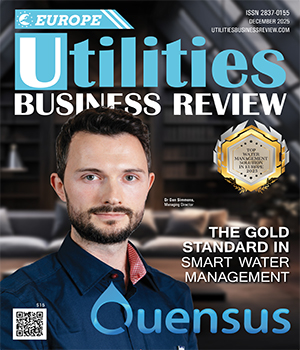
Water damage starts small; faint stains across a wall or a quiet trickle that goes unnoticed. Though seemingly harmless at first, it can jeopardise a property’s structural integrity and lead to serious health and financial consequences—a lesson Dr Dan Simmons learned the hard way. While renovating his first home, he didn’t expect that slow leaks hidden behind plaster would turn his dream project into a costly, mould-ridden ordeal. While simple leak detection alerts were available, Dr Simmons saw a need for proactive prevention—a complete system that learns and acts automatically. The experience—part frustration, part revelation—stayed with him. Determined to create a solution, Dr Simmons founded Quensus in 2015. From overcoming the hurdles of being the first-to-market to weathering the strain of the pandemic, the company has surpassed every obstacle to become an industry leader in smart water management. “Our origin story is baked into our DNA and forces us to think differently,” says Dr Simmons, managing director. “We are a team dedicated to safeguarding the spaces where people live and work by harnessing the power of advanced AI-powered technology.” Dr Simmons is an AI technician and water conservationist with nearly two decades of academic and industry leadership. After earning his PhD in Electrical and Electronic Engineering from the University of Nottingham, he developed dynamic-threshold, leak-detection algorithms that continue to serve as the foundation of his research and innovations in water conservation. He continues to drive Quensus’ vision and innovation. Intelligence at the Core At Quensus, water management isn’t a one-off hardware sale. It has built a complete, intelligently orchestrated ecosystem to help properties manage water as a strategic resource and reduce waste. Its offerings stand out for their intelligence and adaptability, while a comprehensive, customer-centred approach guarantees every solution delivers real-world impact. LeakNet, Quensus’ flagship product, acts as a vigilant, always-on guardian for a building’s entire water system. After installation, it gathers highresolution flow data, which is wirelessly streamed to the company’s cloud platform. Machine learning algorithms analyse the information, learning the distinct ‘water heartbeat’ of the property. The system monitors typical water consumption patterns and detects anomalies in real time, automatically shutting off the supply and sending instant alerts through the FlowReporter app—the user-facing environment of the cloud platform.
CXO INSIGHTS

Building VPPS: From Reactive Services to Strategic Foresight
Mark Meyrick, General Manager, Ecotricity

Leading the Low-Carbon Transition in Energy
Marcos Matijasevich, Head of Low Carbon Transition, Essar Oil [NSE: ESRO]

The Journey Towards a Low-Carbon Future
Tim Harwood, Hydrogen Programme Director, Northern Gas Networks
H2-Solution for the Heating Market?
Dr. Arnt Baer, Head of Policy and Associations, GELSENWASSER AG

Delphy Underground Storage System: The Right Fit for Green Hydrogen Market Needs
Vincent Designolle, Director of Delphy Hydrogen Storage, Vallourec

How we find our Spark at Utility Warehouse
Libby Townsend, Chief People Officer, Utility Warehouse

Building Equitable Pathways in Western Energy
Pamela Sporborg, Director, Transmission & Markets, Portland General Electric [NYSE: POR]


IN FOCUS

Digital innovations driving efficiency in European water systems
Europe advances water management with smart monitoring, analytics, and sustainable innovations, ensuring efficiency, conservation, and reliable resources for future generations.

Intelligent Water Management is Reshaping Europe's Water Future
Intelligent water management integrates sensors, AI, and networks to optimise supply, reduce waste, and ensure regulatory compliance, supporting resilient, efficient, and sustainable European water systems.
EDITORIAL
Intelligent Water Management: From Hidden Risks to Predictive Control
Water management has shifted from a routine operational task to a strategic priority. Ageing infrastructure, rising consumption, climate volatility, and tightening regulatory expectations have forced utilities, property owners, and industrial operators to rethink how water is monitored, controlled, and conserved. Today, the challenge is no longer limited to preventing burst pipes or responding to overuse. The real risks lie in the micro leaks behind walls, silent losses across large portfolios, and inefficiencies that accumulate into high financial and environmental costs.
A new generation of intelligent water management solutions is stepping in to address these gaps. Real-time sensors, cloud analytics, autonomous shutoff systems, and data-driven reporting are transforming water from a reactive utility into a continuously managed resource. This shift is redefining how utilities safeguard infrastructure, meet sustainability targets, and deliver resilience at scale. However, the complexity of implementation from integrating with legacy systems to ensuring data accuracy remains a critical challenge that only a few companies have successfully addressed.
This edition features Quensus, a standout innovator in the space, exemplifying how intelligence and practicality can coexist in modern water systems. Its LeakNet platform learns a building’s unique water signature, detecting anomalies in seconds and acting without hesitation. Combined with the FlowReporter app, operators gain clear, actionable insights rather than being overwhelmed by data streams.
What sets Quensus apart is its commitment to removing the barriers that traditionally slow adoption: seamless integration, adaptable installations, and a design philosophy rooted in realworld operational needs. In an industry where solutions often promise more than they deliver, Quensus has built a system that quietly works, consistently protects, and continually improves.
As utilities across Europe strive for more intelligent and resilient networks, it is evident that the future of water management hinges on intelligence, responsiveness and collaboration. The companies leading this transition are redefining how water is valued, monitored, and safeguarded for decades to come.
